 EN
EN

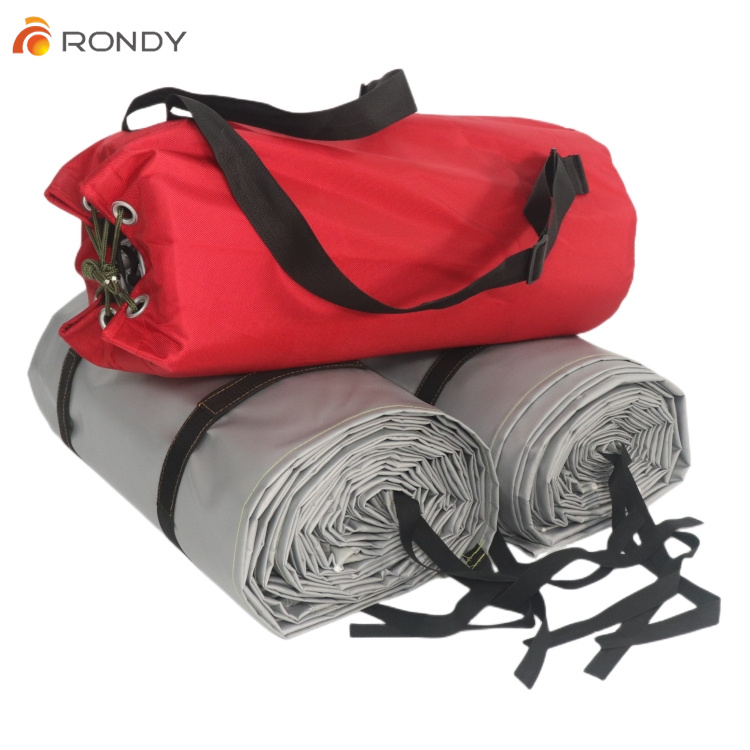
Industrial Fiberglass Fire Blanket: Critical Use Scenarios
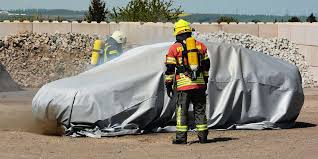
A lithium-ion battery pack in an electric vehicle parked inside a multi-story repair facility began thermal runaway — the self-sustaining exothermic reaction that releases temperatures exceeding 900°C within seconds. The facility's emergency protocol called for an EV fire blanket rated for at least 1000°C instantaneous exposure. A 1.7mm fiberglass fire blanket was deployed over the vehicle, smothering the flames, containing toxic off-gassing, and preventing the fire from spreading to adjacent vehicles within three minutes of application. The blanket remained in place for 45 minutes until the battery pack completed its thermal discharge — something water-based suppression systems cannot achieve with lithium-ion fires because water reacts with burning lithium to produce hydrogen gas.
An industrial EV fire blanket is not a convenience. In specific scenarios — EV battery fires, shipyard welding operations, petrochemical facility hot work, foundry maintenance — it is the difference between a contained incident and a facility-wide catastrophe.
When Sparks Become a Liability
Electric vehicle battery fires represent the fastest-growing industrial fire scenario globally. Unlike internal combustion engine fires, lithium-ion battery fires are not extinguishable by conventional means — water cools the battery pack but does not stop the electrochemical reaction inside each cell. A fiberglass fire blanket rated to EN1869 and capable of withstanding continuous temperatures of 550°C and instantaneous spikes to 1000°C provides containment rather than extinguishment — smothering the fire, limiting oxygen supply, and preventing propagation to surrounding vehicles, structures, and personnel. Parking garages, auto repair facilities, EV service centers, and vehicle transport operations increasingly deploy EV fire blanket systems as a primary containment tool after fire departments in Oslo, Paris, and multiple US cities reported incidents where EV fires spread beyond initial suppression capability.
Shipbuilding and offshore platform maintenance create a different fire blanket requirement. Hot work — welding, grinding, and plasma cutting — generates molten metal spatter at temperatures exceeding 1500°C. When this spatter lands on painted steel, cable trays, hydraulic lines, or adjacent scaffolding, secondary fires ignite within seconds. A heavy-duty fiberglass fire blanket (1.0mm-1.7mm thickness, typically 1700g/m²) draped as a welding curtain or floor covering catches spatter before it reaches vulnerable surfaces. Offshore platforms and shipyards in the North Sea, Gulf of Mexico, and Southeast Asian waters specify fiberglass fire blankets as standard PPE because the consequence of an uncontrolled fire on a confined offshore structure is evacuation or total loss.
Petrochemical facilities present the third critical scenario. Hot work within 35 feet of process piping containing flammable hydrocarbons requires fire-resistant barriers that do not burn, melt, or produce toxic smoke. A 1.0mm HT800 fiberglass fire blanket with satin-weave construction and heat-treated surface provides a continuous use rating of 800°C — sufficient for welding spark protection in Zone 1 and Zone 2 hazardous areas. The non-combustible nature of fiberglass — it does not ignite, drip, or contribute fuel to the fire — makes it the only textile-based fire barrier permitted for hot work near hydrocarbon processing equipment under NFPA 51B (Standard for Fire Prevention During Welding, Cutting, and Other Hot Work).
Frequently Asked Questions
What scenarios absolutely require an industrial fiberglass fire blanket?
EV battery fire containment (thermal runaway events exceeding 900°C), shipyard and offshore platform hot work where welding spatter contacts painted steel and hydraulic lines, petrochemical facility hot work within 35 feet of hydrocarbon piping, foundry maintenance with molten metal splash risk, and any confined-space operation where conventional fire suppression systems cannot access the fire source.
How does an EV fire blanket work on a lithium-ion battery fire?
The blanket smothers the fire by limiting oxygen supply to the battery pack, contains toxic off-gassing (hydrogen fluoride, carbon monoxide) within the blanket envelope, and prevents flame propagation to adjacent vehicles or structures. It does not extinguish the electrochemical reaction — it contains the fire until the battery pack completes thermal discharge, typically 30-90 minutes.
What is the difference between EN1869 and NFPA 701 certification for fire blankets?
EN1869 is the European standard specifically for fire blankets used in kitchens and industrial applications — it tests fire containment performance, handle temperature, and material integrity under direct flame exposure. NFPA 701 tests fabric flammability — flame spread rate and after-flame duration. EN1869 is the more demanding standard, requiring the blanket to extinguish a cooking oil fire and remain intact throughout deployment.
What thickness of fiberglass fire blanket is needed for heavy industrial use?
0.5mm (430g/m²) for light welding spatter protection and general-purpose heat shielding. 1.0mm (HT800, ~800g/m²) for shipbuilding, pipeline welding, and petrochemical hot work with continuous 800°C rating. 1.7mm (1700g/m²) for heavy foundry work, EV fire containment, and applications requiring superior spatter resistance. The thickness selection depends on spatter intensity, exposure duration, and whether the blanket contacts molten metal directly.
Can fiberglass fire blankets be reused after deployment?
Yes, provided the blanket is inspected for holes, tears, coating degradation, and carbonized residue. A blanket that has been exposed to direct flame for extended periods or has visible damage should be replaced. Blankets used for light spatter protection with no visible damage can be cleaned and returned to service after inspection against the original certification requirements.
Why can't conventional fire extinguishers handle EV battery fires?
Lithium-ion battery fires involve an exothermic electrochemical reaction that generates its own oxygen — smothering with CO₂ or dry chemical is ineffective because the fire does not require external oxygen. Water cools the battery pack but reacts with burning lithium to produce flammable hydrogen gas. Containment with a fiberglass fire blanket until the reaction completes is the only reliable non-intervention strategy currently available for parking structures and repair facilities.